Itemizing Security Deposit Deductions So They Hold Up
A deposit deduction is only as strong as the itemized statement behind it. Here is how to build each line so it survives a dispute: the damage, the dated proof, the real cost, and the deadline.
Posted by
 William H. Mason
Related reading
How to Handle a Security Deposit Dispute
When a tenant disputes your deposit deductions, the outcome comes down to your records and your deadline. Here is how to handle a dispute, step by step, and how to win one.
How to Write a Property Condition Report (With a Free Template)
A clear, dispute-ready property condition report protects your deposit decisions. Here is what to record at move-in and move-out, room by room, and how to keep it.
Move-In vs Move-Out: Documenting the Difference That Wins a Deposit Dispute
A deduction is never about how the unit looks at move-out. It is about how much it changed. Here is how to document both walkthroughs so the difference between them is obvious and holds up.

Keeping part of a security deposit is the easy part. Making the deduction hold up when the tenant pushes back is where most landlords lose. The deposit dispute is not won at the walkthrough, it is won in the itemized statement you send afterward.
That statement is a legal document. In most states a landlord who deducts from a deposit has to provide an itemized list of what was kept and why, within a set number of days, or risk losing the right to deduct at all.
This guide walks through how to build each line of that statement so it survives scrutiny. The pattern is the same every time: identify the damage, prove it changed, price it honestly, and deliver it on the clock.
Why the Itemized Statement Is the Whole Ballgame
A security deposit is the tenant's money, held in trust, not the landlord's to keep by default. The burden of proof sits with the landlord, which means a deduction the tenant disputes is one you have to justify, not one they have to disprove.
That is why a vague statement fails. "Cleaning and repairs, 600 dollars" tells a tenant or a small-claims judge nothing about what was damaged, what it cost, or why it was the tenant's responsibility. A general overview of a landlord's rights and limits on deposit deductions is laid out in Nolo's guide to deposit deductions.
An itemized statement that holds up does the opposite. Each line names one specific thing, ties it to evidence, and shows a real cost. The rest of this post is how to build those lines.
What You Can Actually Deduct For
There are only a few categories a deposit can legally cover, and they are narrower than many landlords assume. Knowing the categories keeps you from writing a line you cannot defend.
- Damage beyond normal wear and tear: holes, breaks, stains, and harm that goes past the ordinary aging of a lived-in unit.
- Cleaning to return the unit to its move-in level of cleanliness, but not to make it cleaner than the tenant received it.
- Unpaid rent or unpaid charges the lease clearly allows.
- Other tenant-caused costs the lease spells out, such as unreturned keys or removal of belongings left behind.
The line you cannot cross is normal wear and tear. Faded paint, lightly worn carpet in traffic paths, and small nail holes are the cost of doing business, not deductible damage. The distinction is the single most disputed point in deposit cases, and Nolo's breakdown of wear versus damage is a useful reference for where the line sits.
The Anatomy of a Deduction Line That Holds Up
Every defensible line on an itemized statement has four parts. Miss any one of them and the line gets weak, because the tenant can challenge the gap you left.
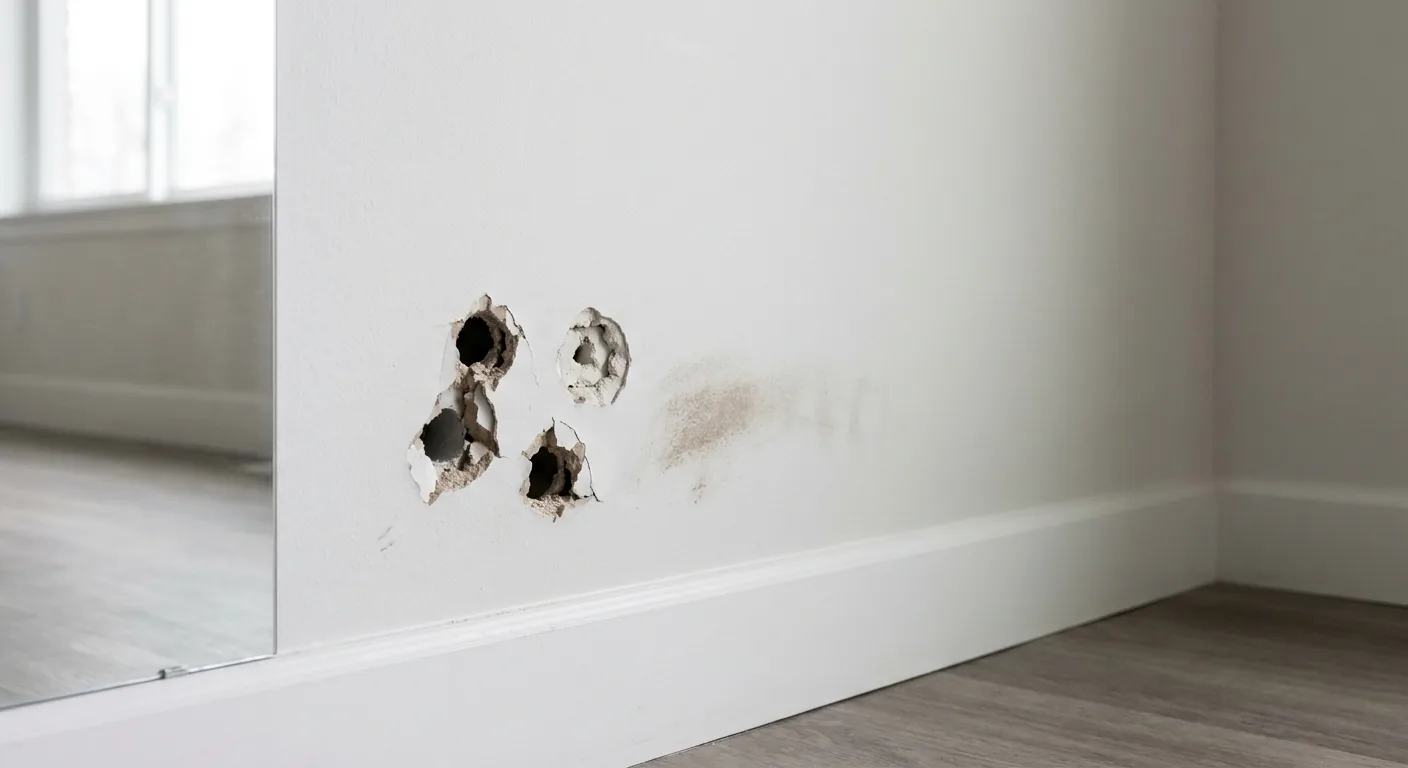
Take the wall above. A strong line reads as one item with its proof attached, not as a lump sum buried in a total.
- The specific item: "Bedroom wall, cluster of large anchor holes and a dent," not "wall repair."
- The dated proof of change: a move-out photo of the damage paired with the move-in photo of the same wall intact.
- The cost basis: the actual repair cost, backed by a receipt or a written estimate.
- The amount kept: the dollar figure deducted, traceable straight back to that receipt.
The dated pair is what turns a photo into evidence. A move-out photo proves damage exists today, but only the before-and-after pair proves the tenant caused it during the tenancy. Building that pair is the entire point of our guide to documenting the difference between move-in and move-out.
Use the Real Cost, Not a Round Number
Round numbers are a red flag. A deduction of "500 dollars" with no receipt looks invented, while "437 dollars, drywall patch and repaint, per the attached invoice" looks like what it is. Keep every receipt, invoice, and written estimate, and attach copies to the statement.
Cost also has to account for the age of what was damaged. You generally cannot charge a tenant the full price of brand-new carpet when the carpet they damaged was already half-way through its useful life. Most fixtures depreciate, and charging full replacement on a worn item is one of the fastest ways to lose a deposit case.
When the damage is severe enough that the item truly had no remaining life, document that too. The goal is always the same: the number you keep should match a cost you can show, adjusted for what the item was actually worth.
Cleaning, Unpaid Rent, and the Gray Areas
Cleaning is the most abused deduction. You can charge to bring the unit back to its move-in cleanliness, but not to upgrade it, and not for the routine turn cleaning that comes with any tenancy. A unit left genuinely filthy is chargeable, and a photo of the actual condition is what separates that from a habitual cleaning fee a court will throw out.
Unpaid rent and lease-authorized charges are usually the cleanest deductions, because the lease and the ledger are the proof. Even then, list each charge as its own line with the dates and the lease clause behind it. Do not fold rent into a repair line, because blending categories makes the whole statement look careless.
Deliver It on the Clock
Almost every state puts a hard deadline on returning the deposit with its itemized statement, and the penalty for missing it can be severe. California requires the itemized statement within 21 days and receipts for repairs over a set amount, as the California Courts self-help guide explains.
Texas sets a 30-day window for the refund and itemization, detailed in the Texas State Law Library's security deposit guide. Your state has its own clock, so confirm it before the tenant moves out, not after.
Miss the deadline and you can forfeit the right to deduct anything, and in some states owe the tenant a penalty on top of the full deposit. The basic structure of these obligations sits within the broader landlord-tenant framework summarized by the Cornell Legal Information Institute. A statement that is right but late can still cost you everything.
Where Itemizations Fall Apart
The failures are predictable, and they are almost all about missing proof rather than bad intent. If you have ever lost a deposit dispute, the cause is probably on this list.
- No move-in record, so there is nothing to prove the damage was not already there.
- Round-number charges with no receipts or estimates behind them.
- Deducting for normal wear and tear, which a tenant can challenge on principle.
- Charging full replacement cost on an item that was already old and worn.
- A vague catch-all line like "repairs and cleaning" with no breakdown.
- Sending the statement after the legal deadline.
Every one of these is a documentation problem, not a judgment problem. The fix is to capture the right evidence at the right time and keep each line tied to it.
Make Every Line Defensible by Default
The hard part of an itemized statement is not the math, it is having the proof ready when you sit down to write it. That proof has to be captured during the move-out walkthrough, which is why a complete and consistent inspection matters so much. Our guide to what a move-out inspection should cover lays out the coverage that feeds each deduction line.
A property inspection app makes the statement almost write itself, because it pairs each finding with its dated photo as you walk the unit. When the walkthrough is done you can turn your move-out photos into an itemized condition report where every line already carries the evidence behind it. For the format itself, our walkthrough of how to write a property condition report covers what each finding should say.
It starts at move-in, not move-out. A baseline taken the day the tenant gets the keys is what every later deduction is measured against, and our free move-in and move-out checklist gives you the same room-by-room record at both ends so the comparison is real.
It is worth saying plainly what this report is and is not. It is structured condition documentation you create from your own photos, reviewed and edited by you before it is final. It is not a licensed or professional home inspection or appraisal, and it is not legal advice or a substitute for either.
Treat the deposit as the tenant's money you are accountable for, and the rest follows. Rental records also matter well past a single tenancy, which the rental-property guidance in IRS Publication 527 is a good reminder of. Build each line on a dated photo and a real receipt, send it on time, and you can keep dispute-ready move-out records that hold up if anyone ever asks.
Turn your next walkthrough into a clean report
Snap photos at move-in, move-out, or a routine inspection and get a branded condition report you can hand a tenant or keep on file.
✓ Review every finding before you finalize ✓ Web report and PDF ✓ Cancel anytime
Frequently Asked Questions
Each deduction listed as its own line with a specific description of what was damaged or owed, the dollar amount kept, and the proof behind it, such as photos and receipts or estimates. Most states also require you to return the unused portion of the deposit and to send the statement within a set deadline. Check your state's exact requirements.
Usually not. Most items depreciate, so you generally cannot charge full replacement cost for something that was already partway through its useful life when it was damaged. The defensible amount reflects the actual repair or replacement cost adjusted for the age and condition of the item.
It varies by state, but missing the deadline can mean forfeiting your right to deduct anything, and in some states owing the tenant a penalty on top of returning the full deposit. A correct statement that is sent late can still cost you the entire deduction, so confirm your state's deadline before the tenant moves out.
No. It is structured condition documentation a landlord or property manager creates from their own photos, and you review and edit every finding before it is final. It is not a licensed or professional home inspection or appraisal, and it is not legal advice. Consult an attorney or your local housing authority for the rules in your area.